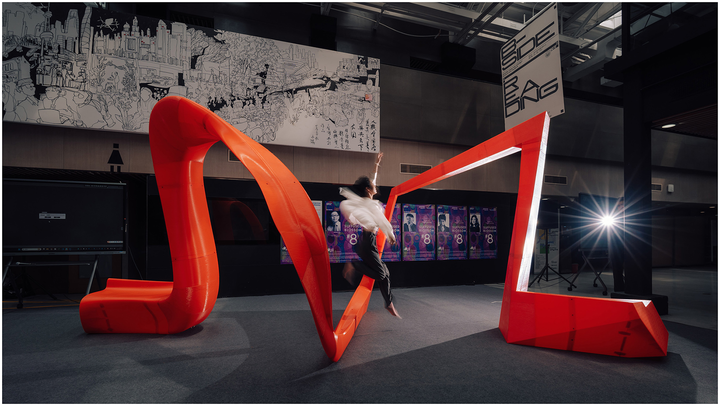
Abstract
This paper presents a multi-stage framework that integrates architectural design logic with empirical testing across representational scales. This exploratory, practice-driven research paradigm seeks to bridge disciplinary divides between (1) empirical rigor and situated experience, (2) visual abstraction and embodied spatial engagement, and (3) neuroscientific measurement and architectural meaning. Through a systematic reassessment of dominant methodological assumptions in current neuroaesthetics and neuroarchitectural studies, with curvature serving as a test case, the paper develops a three-phase experimental approach comprising image-based evaluation (Phase 1), object-based interaction (Phase 2), and full-scale immersive experience (Phase 3), supported by a stimulus-generation pipeline rooted in spatial logic and architectural composition. The paper details the design rationale and implementation of stimuli across all phases. Findings from Phase 1 are briefly presented to (i) illustrate the framework’s capacity to generate perceptually distinct stimuli and reveal recurring evaluative patterns, including foreground-sensitive preferences for curvature under controlled figure–ground manipulations; and (ii) inform the methodological calibration and design logic of subsequent Phase 2 and Phase 3 investigations, which are currently ongoing and are presented in terms of methodological structure and exploratory potential. Rather than treating the architectural environment as a passive object of evaluation, the framework positions it as a generator of perceptual, affective, and behavioral data within an iterative research process. Scalable and adaptable, this approach supports collaborative investigations across multiple contexts and offers a pathway for advancing neuroarchitectural research and progressively increasing ecological validity. Several key terms are employed in their architectural sense to support cross-disciplinary dialogue.