Abstract
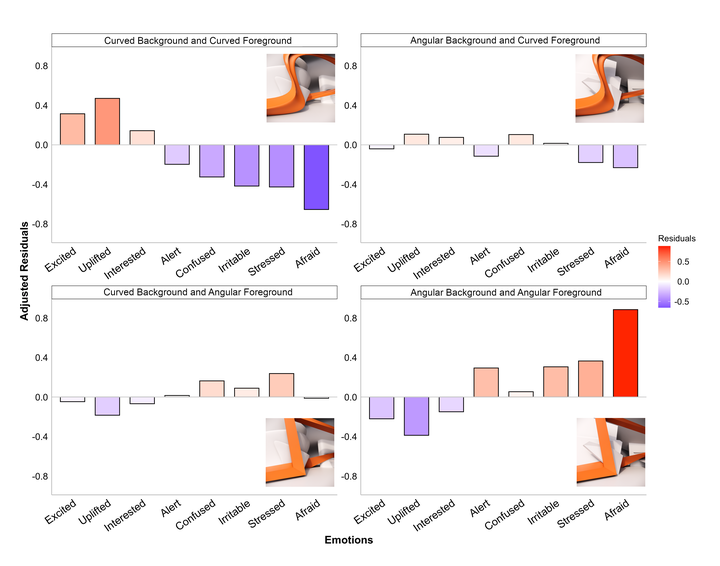
Architects have long assumed that curvature enhances positive emotional and aesthetic experiences of architectural spaces. While empirical evidence for this claim exists, conflicting results have also been reported, possibly because curvature information is experienced differently in different architectural contexts. Here, we sought to control the conditions under which architectural curvature is experienced by asking an architect to design interior spaces that varied systematically in the use of curvilinear and angular forms. Specifically, we constructed versions of the same interior space such that curvilinear and angular forms were either present in the foreground or in the background, and asked participants (N = 30) to rate them on different experiential dimensions, including liking, beauty, coherence, fascination, hominess, emotional responses, as well as their willingness to spend time in the space. Results revealed a strong main effect of curvature. Curvilinear spaces were rated as more aesthetically pleasing and emotionally positive than angular spaces. Curvature also positively influenced ratings of coherence, fascination, hominess, and willingness to spend time. Strikingly, these effects were more pronounced when the curvilinear elements were placed in the foreground of the architectural space than when placed in the background. Together, these results not only lend further support to the thesis that curvature exerts a positive influence on the hedonic and aesthetic experience of architectural spaces, but also show that the effect of curvature is modulated by its placement in the architectural space. This finding has practical implications for architects interested in the question of how architectural design might enhance human well-being.